Understanding the 4 Functions of Behavior
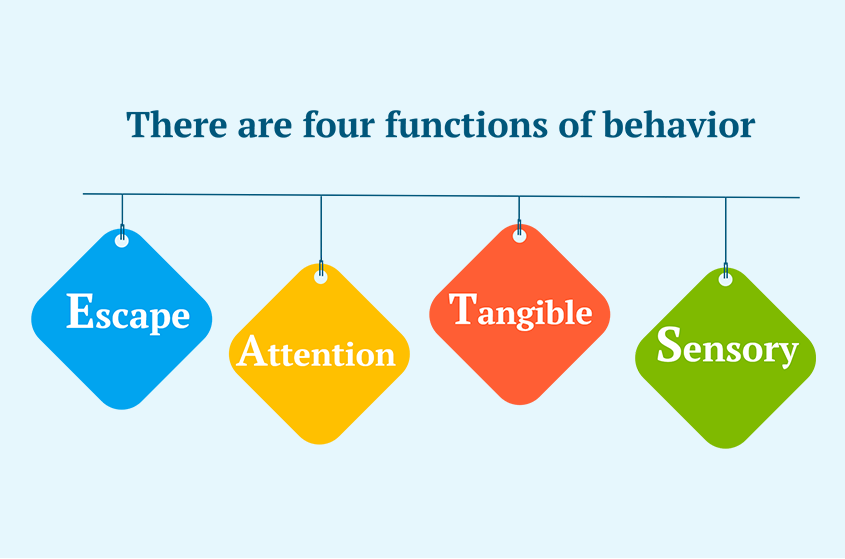
When trying to understand why people behave the way they do, especially in fields like ABA therapy, education, or parenting, it’s important to look beyond the behavior itself and focus on its function—the reason why it’s happening.
In behavior analysis, there are four primary functions of behavior. Every behavior—whether positive or challenging—serves at least one of these functions. Once you understand them, you can respond more effectively and support meaningful change.
What Are the 4 Functions of Behavior?
The four functions are:
- Attention
- Escape (or Avoidance)
- Access to Tangibles
- Sensory (Automatic Reinforcement)
Let’s break each one down with clear explanations and relatable examples.
1. Attention

What It Means
A behavior occurs because the person wants attention from others. This attention can be positive (praise, laughter) or negative (scolding, correction)—both still count.
Examples
- A student calls out in class to get the teacher’s attention.
- A child throws a tantrum because a parent is talking on the phone.
- Someone exaggerates a story to make others laugh.
Key Insight
Even negative attention can reinforce behavior. If a behavior consistently gets a reaction, it’s likely to continue.
2. Escape (Avoidance)
What It Means
The behavior happens to avoid or get out of something—usually a task, demand, or uncomfortable situation.
Examples
- A student says they feel sick to avoid taking a test.
- A child cries when asked to clean up their toys.
- Someone suddenly checks their phone to avoid an awkward conversation.
Key Insight
If a behavior successfully removes the unwanted task, it becomes more likely to happen again in similar situations.
3. Access to Tangibles
What It Means
The behavior is used to gain access to something desirable, like an object, activity, or privilege.
Examples
- A child screams in a store to get a toy.
- A teen argues to get more screen time.
- A student rushes through work to earn free time.
Key Insight
If the person gets what they want after the behavior, it reinforces that behavior—even if it’s not appropriate.
4. Sensory (Automatic Reinforcement)
What It Means
The behavior is internally reinforcing—it feels good or satisfies a sensory need, without needing input from others.
Examples
- A child rocks back and forth because it’s calming.
- Someone taps their foot repeatedly out of habit.
- A person listens to the same song over and over because it’s satisfying.
Key Insight
This type of behavior doesn’t rely on others, which can make it more challenging to change—but not impossible.
Why Understanding Function Matters
Instead of asking, “How do I stop this behavior?”, a better question is:
“Why is this behavior happening?”
When you understand the function, you can:
- Teach more appropriate replacement behaviors
- Reduce frustration for both you and the individual
- Create more effective interventions
For example:
- If a behavior is for attention → teach appropriate ways to ask for attention
- If it’s for escape → teach requesting breaks
- If it’s for tangibles → teach patience and communication
- If it’s sensory → provide safe, alternative sensory input
Final Thoughts
Behavior is communication. Every action tells you something—even if it’s not said out loud.
By identifying whether a behavior is driven by attention, escape, access, or sensory needs, you move from reacting to behavior… to truly understanding it.
And that’s where real change begins.
Quick Summary
- Attention → “Look at me!”
- Escape → “I don’t want to do this.”
- Access to Tangibles → “I want that.”
- Sensory → “This feels good.”
If you’re working in ABA, education, or even just navigating everyday interactions, keeping these four functions in mind can completely change how you respond—and how effective you are.
Comments
Post a Comment