Prompt Hierarchy in ABA Therapy: Guiding Learners Toward Independence

One of the most powerful and most misunderstood tools in applied behavior analysis (ABA) is the prompt hierarchy. It sounds technical, but the idea is elegantly simple: meet the learner where they are, give them just enough support to succeed, and then systematically pull that support away so they can eventually do it on their own. That process is called prompt fading, and it's one of the most important things a behavior technician or educator can understand.
What is a Prompt Hierarchy?
A prompt hierarchy is an organized system of cues arranged from most supportive to least supportive. The goal is never to rely on prompts forever — prompts are scaffolding. The end goal is always independence. When we skip this structure, we risk creating prompt dependency, meaning a learner waits for a cue before they ever initiate a skill on their own.
There are two main ways to move through the hierarchy: most-to-least prompting (start with maximum support and fade down) and least-to-most prompting (start minimal and add support only if needed). For learners who are brand new to a skill or who have experienced a lot of failure in the past, most-to-least is often the better starting point — it builds success from the very first trial. Check out this video below to help understand the explanation!
Step 1: Full Physical Prompt

A full physical prompt means the therapist physically guides the learner through the entire motion, hand-over-hand or body-over-body.
Consider a 6-year-old learner who is learning to wash his hands. He has no imitation skills yet and doesn't respond to verbal instruction. His therapist stands behind him, takes both of his hands, and physically moves them through each step — turning the faucet, wetting the hands, applying soap, and rubbing. The learner experiences success on every trial. He is reinforced immediately after.
Why this matters long-term: full physical prompting ensures the learner contacts reinforcement from the very beginning. This builds a positive history with the task. Without that foundation, a learner may avoid the activity altogether because it has only ever produced frustration.
Step 2: Partial Physical Prompt

Once the learner reliably completes the skill with full physical guidance and data shows he's anticipating the next step, the therapist fades to a light touch, a gentle hand on the wrist rather than full hand-over-hand. This is an important distinction because the therapist is no longer doing the skill with the learner. They are nudging him into initiating it himself. I f he stalls, support increases temporarily and is then faded again.
Why this matters long-term: partial prompts preserve learner momentum. They prevent the skill from becoming "the therapist's job" rather than the learner's own behavior.
Step 3: Model Prompt
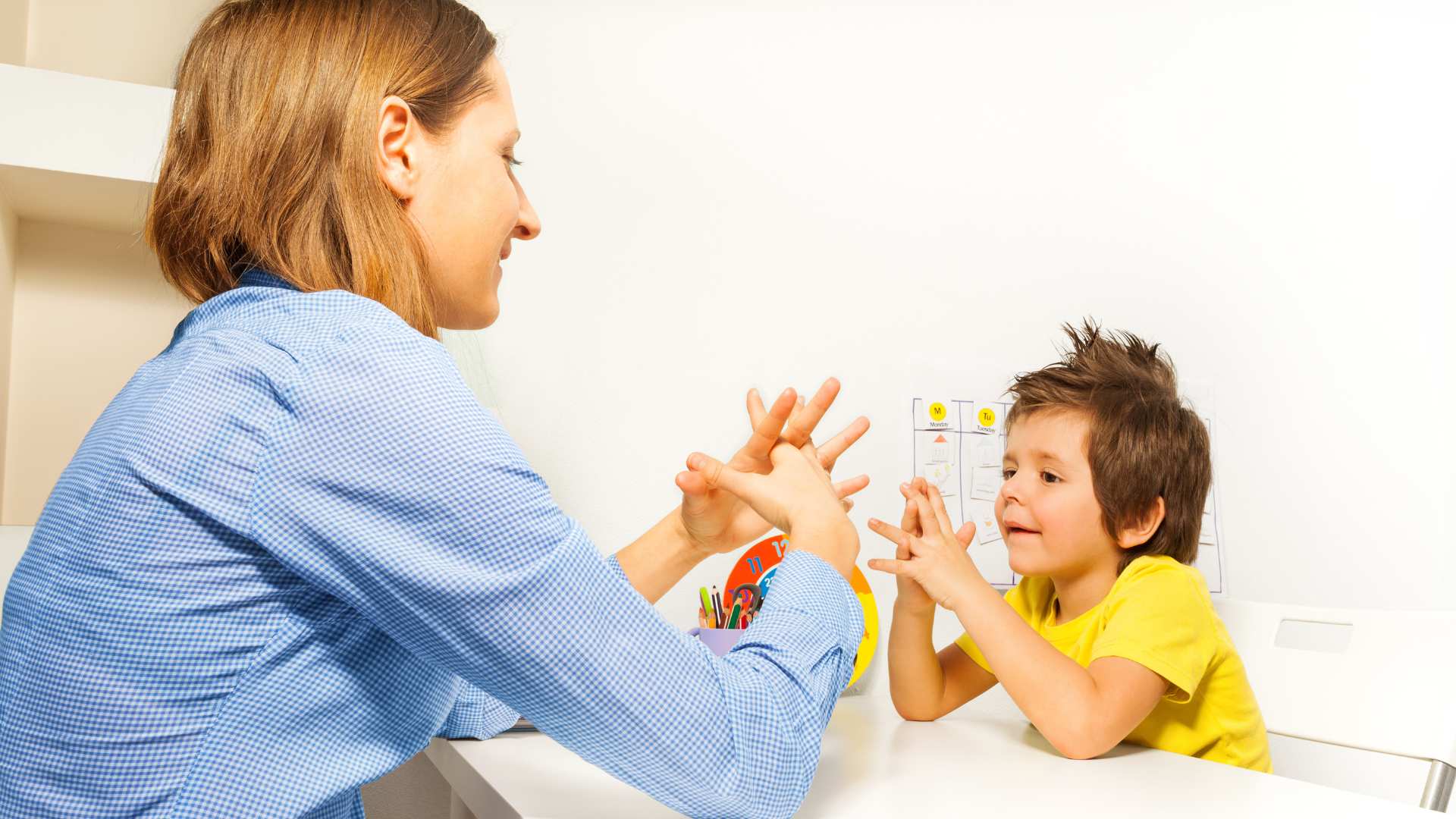
The therapist demonstrates the step — "Watch me!" — turns on the faucet themselves, then offers the learner the opportunity. This leverages observational learning and is especially powerful for learners who have developed imitation skills.
Why this matters long-term: modeling is a naturally occurring social cue. In the real world, people learn by watching others. Building a response to a model prompt prepares learners for classroom and community environments where teachers and peers demonstrate skills constantly.
Step 4: Gestural Prompt

The therapist points to the faucet, taps the soap dispenser, or nods toward the towel. No words. No touch. Just a directional cue.
Consider another learner, a 9-year-old who is learning to set the table. She knows the steps but sometimes loses her place in the sequence. Her teacher points to the empty placemat when the learner pauses. That's a gestural prompt — a nudge in the right direction without doing the thinking for her.
Why this matters long-term: gestural prompts closely resemble the kinds of social cues we all use every day. A head nod from a coworker, a finger pointing toward the door — these are gestural prompts. Responding to them is a functional social skill in itself.
Step 5: Visual/Positional Prompt
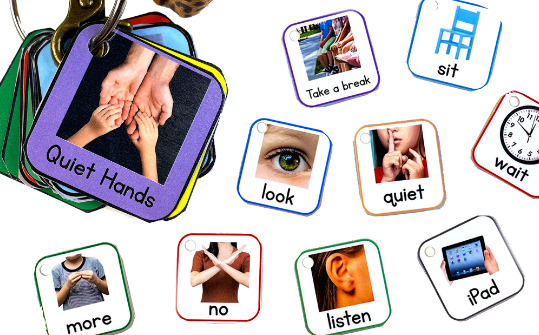
The target item is moved closer, a picture cue is placed on the wall, or a written checklist is available. No person-delivered cue is needed at all.
For learners working on daily living routines, a visual schedule on the bathroom mirror can be a permanent support that promotes independence without relying on another person being present.
Why this matters long-term: visual supports are highly transferable across environments and caregivers. A learner who follows a picture schedule at school can use the same system at home or in a new classroom — without anyone having to re-teach the skill from scratch.
Step 6: Verbal Prompt
A verbal prompt can be a full instruction ("Now wash your hands"), a partial cue ("Now wash your..."), or just a first-sound cue ("W..."). It's the most commonly used prompt — and also the most commonly overused one.
Many learners become dependent on verbal prompts because therapists and teachers default to talking. If a learner only responds when verbally directed, they may struggle in environments where adults are unavailable or too busy to narrate every task.
Why this matters long-term: verbal prompts should be faded just as deliberately as physical ones. The goal is for the skill to come under the control of natural cues — like noticing dirty hands — not a person saying "go wash your hands."
The Goal: Independence
Every step in the hierarchy exists to be eliminated. Data should drive decisions about when to fade — typically, a set criterion like 80% independent responses over three consecutive sessions signals it's time to move to the next level. Rushing fading creates errors; going too slowly creates dependence. The data tells the story.
Whether your learner needs to start with full physical guidance or just a gentle gesture, the prompt hierarchy gives every skill a roadmap from "not yet" to "I can do this on my own."
Comments
Post a Comment